
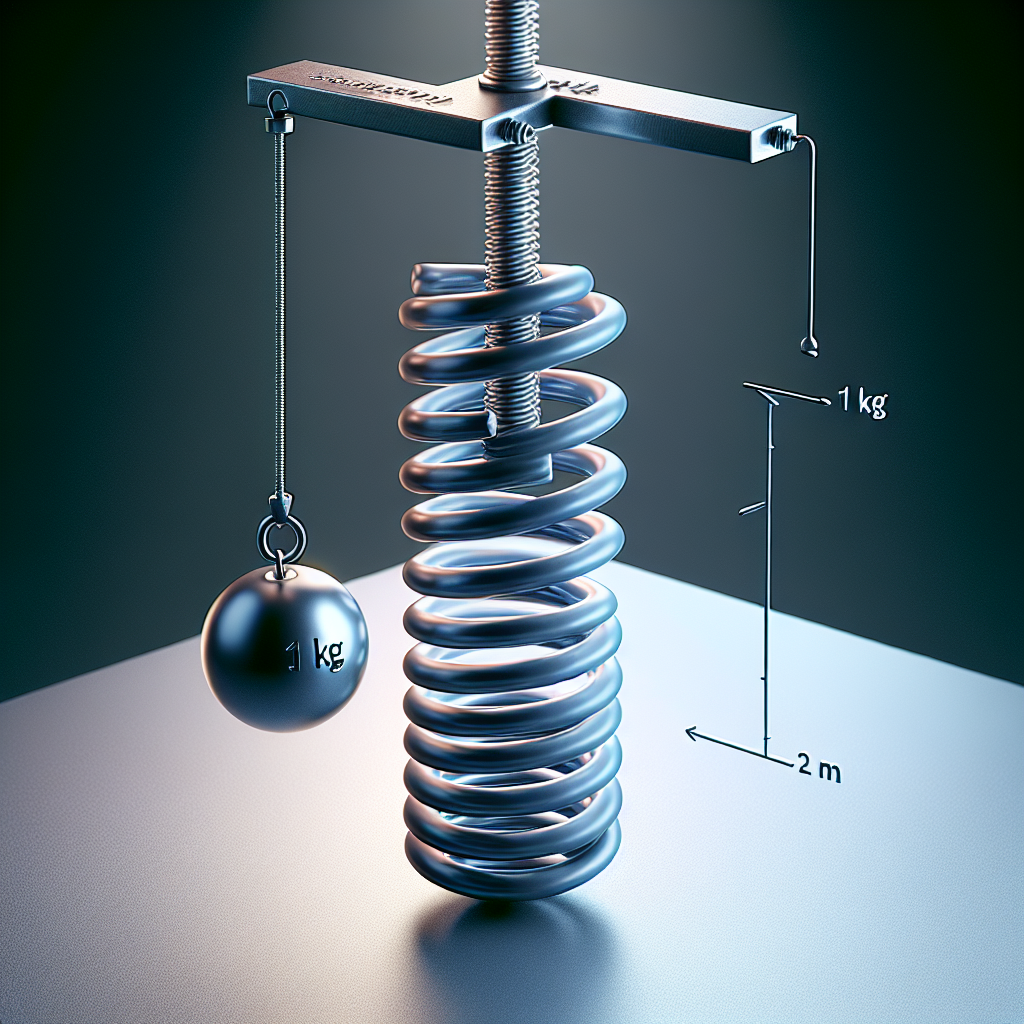
a 1 kg mass is attached to a spring hanging vertically and hangs at rest in the equilibrium position. the spring constant of the spring is 1 n/cm. the mass is pulled downward 2 cm and released. what is the speed of the mass when it is 1 cm above the point from which it was released?
Well, let's do some "spring-loaded" humor calculations, shall we?
First, let's find the potential energy of the mass when it is pulled downward 2 cm. We know that the spring constant is 1 N/cm, so the potential energy can be calculated using the formula:
Potential Energy = (1/2) * k * x^2
Where k is the spring constant and x is the displacement. In this case, x = 2 cm = 0.02 m.
Potential Energy = (1/2) * 1 N/cm * (0.02 m)^2
= (1/2) * 1 N/cm * 0.0004 m^2
= 0.0002 N·m
Now, let's find the kinetic energy when it is 1 cm above the point where it was released.
As the mass rises, the potential energy converts into kinetic energy. So, the kinetic energy at this point will be equal to the potential energy we calculated.
Kinetic Energy = 0.0002 N·m
Now, we can use the formula for kinetic energy to find the speed (v):
Kinetic Energy = (1/2) * m * v^2
Where m is the mass of the object. In this case, m = 1 kg.
0.0002 N·m = (1/2) * 1 kg * v^2
v^2 = 0.0004 m^2/s^2
v = sqrt(0.0004) m/s
v ≈ 0.02 m/s
So, the speed of the mass when it is 1 cm above the point from which it was released is approximately 0.02 m/s.
Hope I didn't "spring" too many surprises with my answer!
the answer is 1.73 but i don't know how can every one help me ??
To find the speed of the mass when it is 1 cm above the point from which it was released, we can use the principles of mechanical energy conservation.
To begin, let's first find the potential energy of the mass when it is 1 cm above the release point. The potential energy of an object attached to a spring can be calculated using the equation:
Potential energy (PE) = 0.5 * k * x^2
Where:
k is the spring constant (1 N/cm)
x is the displacement from the equilibrium position (1 cm)
Plugging in the values, we get:
PE = 0.5 * 1 * (1^2) = 0.5 N-cm
Since the initial potential energy of the mass at rest is zero (as it is at the equilibrium position), the total mechanical energy of the system remains constant throughout.
Next, let's find the kinetic energy of the mass when it is 1 cm above the release point. The kinetic energy of an object can be calculated using the equation:
Kinetic energy (KE) = 0.5 * m * v^2
Where:
m is the mass of the object (1 kg)
v is the velocity of the object
Since the mass is pulled downward 2 cm and released, as it ascends back up, it loses potential energy, which is converted into kinetic energy. At the point 1 cm above the release point, some of the initial potential energy would have been converted into kinetic energy.
At the release point, all the potential energy (0.5 N-cm) is converted into kinetic energy. So, when the mass is 1 cm above the release point, the kinetic energy would be equal to 0.5 N-cm.
Setting the equations for potential energy and kinetic energy equal to each other, we can solve for the velocity (v):
0.5 N-cm = 0.5 * 1 kg * v^2
Simplifying the equation:
1 N-cm = v^2
Taking the square root of both sides:
v = 1 cm/s
Therefore, the speed of the mass when it is 1 cm above the point from which it was released is 1 cm/s.
Max spring potential energy
= (1/2) k X^2 = (100/2)*(0.02)^2
= 0.2 Joules
When 0.01 m below the release point, the spring has 1/4 of its max potential energy, so 0.15 J is available for kinetic energy
(1/2)MV^2 = 0.15 J can be solved for the speed V. I get 0.548 m/s
It is permissible to neglect gravity in this problem when you regard kx as the force applied by the spring, including Mg, with x measured from the equilibrium position. g does not affect the answer or the period of vibration.
To solve this problem, we can use the principle of conservation of mechanical energy, which states that the total mechanical energy of an object remains constant as long as no external forces are acting on it.
Given:
Mass (m) = 1 kg
Spring constant (k) = 1 N/cm
Displacement (x) = 2 cm (initially), x' = -1 cm (final position)
Step 1: Calculate the potential energy at the initial position.
The potential energy (PE) stored in the spring is given by:
PE = (1/2) k x^2
PE_initial = (1/2) * (1 N/cm) * (2 cm)^2
Step 2: Calculate the potential energy at the final position.
PE_final = (1/2) * (1 N/cm) * (-1 cm)^2
Step 3: Calculate the difference in potential energy.
ΔPE = PE_final - PE_initial
Step 4: Calculate the kinetic energy at the final position.
Since the total mechanical energy is conserved, the change in potential energy will be equal to the kinetic energy at the final position.
KE_final = ΔPE
Step 5: Calculate the velocity (speed) at the final position.
The kinetic energy (KE) of an object is given by:
KE = (1/2) m v^2
KE_final = (1/2) * (1 kg) * v^2
Setting KE_final equal to ΔPE, we have:
(1/2) * (1 kg) * v^2 = ΔPE
Solve for v:
v^2 = (2 * ΔPE) / m
v = √[(2 * ΔPE) / m]
Substitute the values:
v = √[(2 * ΔPE) / (1 kg)]
Evaluate ΔPE = PE_final - PE_initial:
v = √[(2 * (PE_final - PE_initial)) / (1 kg)]
v = √[(2 * ((1/2) * (1 N/cm) * (-1 cm)^2 - (1/2) * (1 N/cm) * (2 cm)^2)) / (1 kg)]
Simplify the expression and calculate:
v = √[(2 * (-1 N/cm - 4 N/cm)) / (1 kg)]
v = √[-10 N/kg]
Since the value is negative, it indicates that the mass is moving downward. To find the speed, we discard the negative sign:
v = √[10 N/kg] ≈ 3.16 m/s
Hence, the speed of the mass when it is 1 cm above the point from which it was released is approximately 3.16 m/s.